
Stability before perfection
A rapid change can be more stressful than a small stable deviation. Compare several readings before correcting.
Stable, suitable conditions matter more than one supposedly perfect number. Test consistently and interpret results in the context of aquarium type, inhabitants and plants.
Start for free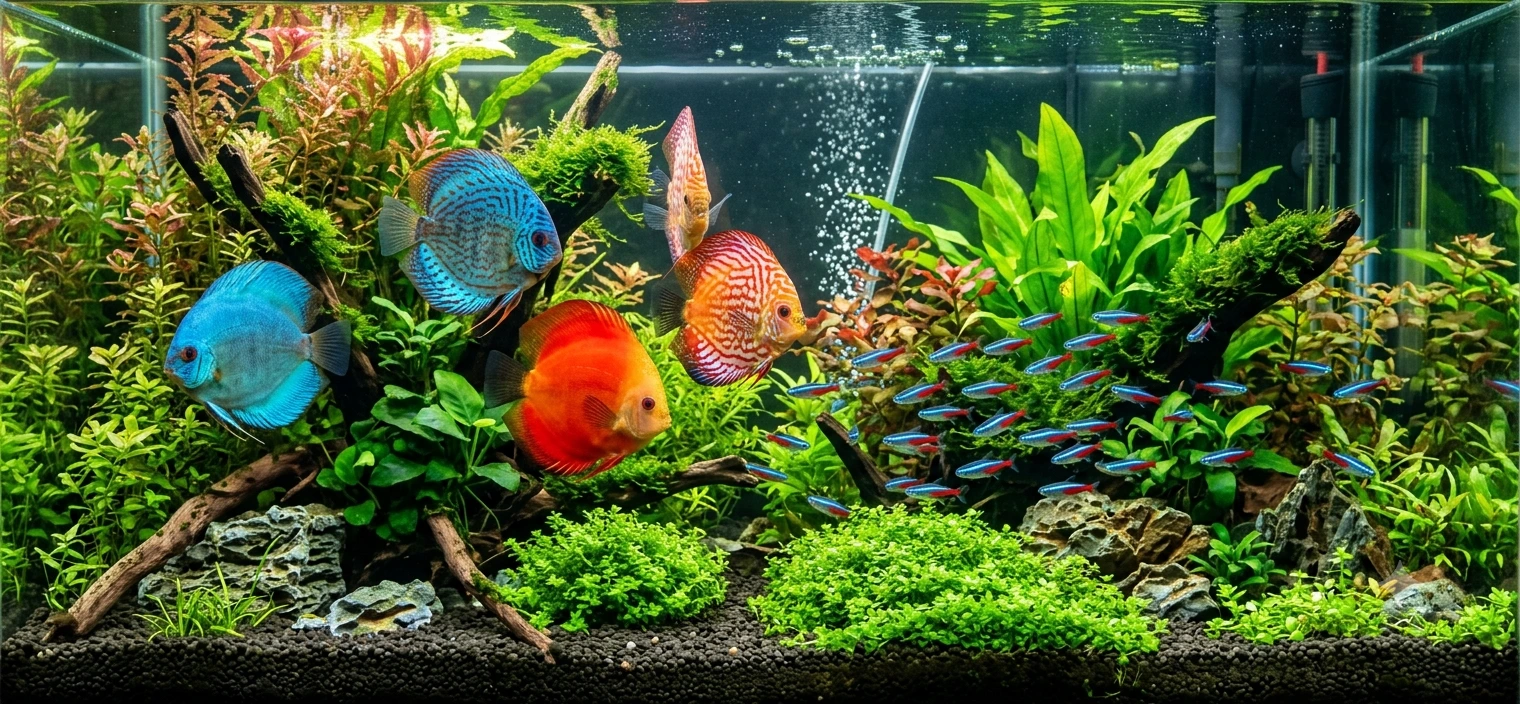
| Parameter | What does it describe? | Key point |
|---|---|---|
| Temperature | Water temperature and process rate | Species-specific |
| pH | Acidity | Assess with KH and CO₂ |
| KH | Carbonate hardness and buffering capacity | Affects pH stability |
| GH | General hardness | Species-specific |
| NH₃/NH₄ | Ammonia and ammonium | Important during cycling and sudden loading |
| NO₂ | Potentially harmful nitrite | Follow up unexpected detection |
| NO₃ | Nitrate from nitrification | Assess the trend |
| PO₄ | Phosphate and nutrient balance | Assess with plants, feeding and algae |
A rapid change can be more stressful than a small stable deviation. Compare several readings before correcting.
pH, KH, GH, nitrite, nitrate and temperature describe different aspects. Tables are starting points, not universal guarantees.
Discus, shrimp, planted, community and breeding tanks may need different ranges.
Check test expiry, calibrate meters and repeat unexpected results.
pH, KH and CO₂ interact; temperature affects oxygen and ammonia balance.
Link readings with maintenance, water changes, dosing, feeding and behaviour.
More often during cycling, after interventions or when values deviate; use a fixed routine in a stable tank.
Temperature, pH, KH, GH, nitrite and nitrate are common core values; others depend on the aquarium.
No. Suitable ranges depend on species, aquarium type, life stage and test method.
Start for free and record your water values.